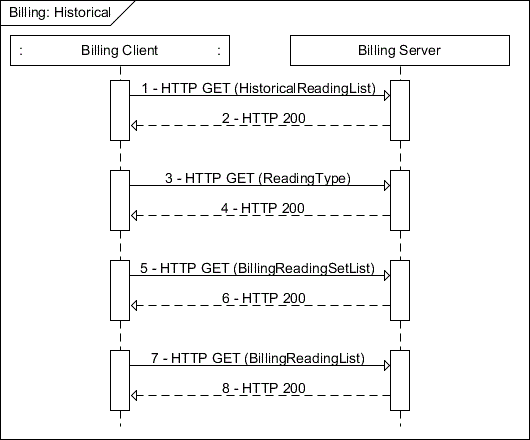
The flow diagram shown in Figure C.16 describes a Billing client device obtaining historical Billing readings.
Figure C.16—Billing historical
Table C.18—POX example: Billing historical
Step | Description |
1 | Client GETs the HistoricalReadingList from the Billing server. Client sends the following request: GET /bill/1/ca/1/ver HTTP/1.1 Host: {hostname} Accept: application/sep+xml |
2 | Billing server responds with the HistoricalReadingList. Server sends the following response: HTTP/1.1 200 OK Content-Type: application/sep+xml Content-Length: {contentLength} <HistoricalReadingList all="1" href="/bill/1/ca/1/ver" results="1" xmlns="urn:ieee:std:2030.5:ns"> <HistoricalReading href="/bill/1/ca/1/ver/1"> <mRID>ce7f99f087b5e3de0000e566</mRID> <description>Hourly usage (kWh)</description> <BillingReadingSetListLink all="180" href="/bill/1/ca/1/ver/1/brs"/> <ReadingTypeLink href="/rt/3"/> </HistoricalReading> </HistoricalReadingList> |
3 | Client GETs the ReadingType from the Billing server. Client sends the following request: GET /rt/3 HTTP/1.1 Host: {hostname} Accept: application/sep+xml |
4 | Billing server responds with the ReadingType. Server sends the following response: HTTP/1.1 200 OK Content-Type: application/sep+xml Content-Length: {contentLength} <ReadingType href="/rt/3" xmlns="urn:ieee:std:2030.5:ns"> <accumulationBehaviour>4</accumulationBehaviour> <commodity>1</commodity> <dataQualifier>12</dataQualifier> <flowDirection>1</flowDirection> <intervalLength>3600</intervalLength> <kind>12</kind> <numberOfConsumptionBlocks>2</numberOfConsumptionBlocks> <numberOfTouTiers>3</numberOfTouTiers> <phase>0</phase> <powerOfTenMultiplier>0</powerOfTenMultiplier> <tieredConsumptionBlocks>false</tieredConsumptionBlocks> <uom>72</uom> </ReadingType> |
5 | Client GETs the BillingReadingSetList from the Billing server. Client sends the following request: GET /bill/1/ca/1/ver/1/brs?l=1 HTTP/1.1 Host: {hostname} Accept: application/sep+xml |
Table C.18—POX example: Billing historical (continued) | |
Step | Description |
6 | Billing server responds with the BillingReadingSetList. Server sends the following response: HTTP/1.1 200 OK Content-Type: application/sep+xml Content-Length: {contentLength} <BillingReadingSetList all="180" href="/bill/1/ca/1/ver/1/brs" results="1" subscribable="1" xmlns="urn:ieee:std:2030.5:ns"> <BillingReadingSet href="/bill/1/ca/1/ver/1/brs/1"> <mRID>82866ecc81c9638a0000e566</mRID> <timePeriod> <duration>86400</duration> <start>1361491200</start> </timePeriod> <BillingReadingListLink all="24" href="/bill/1/ca/1/ver/1/brs/1/br"/> </BillingReadingSet> </BillingReadingSetList> |
7 | Client GETs the BillingReadingList from the Billing server. Client sends the following request: GET /bill/1/ca/1/ver/1/brs/1/br?l=1 HTTP/1.1 Host: {hostname} Accept: application/sep+xml |
8 | Billing server responds with the BillingReadingList. Server sends the following response: HTTP/1.1 200 OK Content-Type: application/sep+xml Content-Length: {contentLength} <BillingReadingList all="24" href="/bill/1/ca/1/ver/1/brs/1/br" results="1" xmlns="urn:ieee:std:2030.5:ns"> <BillingReading href="/bill/1/ca/1/ver/1/brs/1/br/1"> <consumptionBlock>0</consumptionBlock> <qualityFlags>01</qualityFlags> <timePeriod> <duration>3600</duration> <start>1361491200</start> </timePeriod> <touTier>3</touTier> <value>38</value> <Charge> <kind>0</kind> <value>429400</value> </Charge> </BillingReading> </BillingReadingList> |