C.16 Billing: Billing period
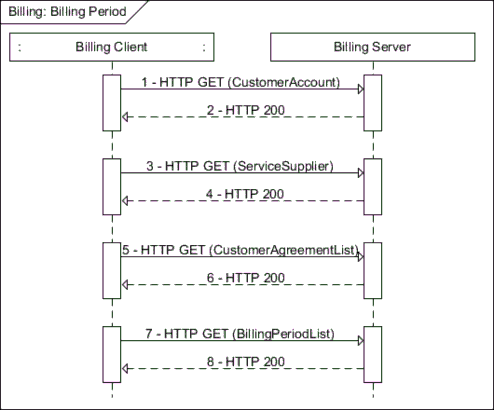
The flow diagram in Figure C.15 describes a Billing client device obtaining Billing information including billing period.
Figure C.15—Billing period
NOTE—In most cases, registration is required to obtain access to Billing, and the client is directed to a specific CustomerAccount through a Link in the FunctionSetAssignments found in their EndDevice FunctionSetAssignmentsListLink.
Table C.17—POX example: Billing period
Step | Description |
1 | Client GETs the CustomerAccount from the Billing server. Client sends the following request: GET /ca/1 HTTP/1.1 Host: {hostname} Accept: application/sep+xml |
2 | Billing server responds with the CustomerAccount. Server sends the following response: HTTP/1.1 200 OK Content-Type: application/sep+xml Content-Length: {contentLength} <CustomerAccount href="/bill/1" xmlns="urn:ieee:std:2030.5:ns"> <mRID>26d0c9722dd639ab0000e566</mRID> <description/> <currency>840</currency> <customerAccount>981273648</customerAccount> <CustomerAgreementListLink all="1" href="/bill/1/ca"/> <customerName>John Doe</customerName> <pricePowerOfTenMultiplier>-6</pricePowerOfTenMultiplier> <ServiceSupplierLink href="/ss"/> </CustomerAccount> |
3 | Client GETs the ServiceSupplier from the Billing server. Client sends the following request: GET /ss HTTP/1.1 Host: {hostname} Accept: application/sep+xml |
4 | Billing server responds with the ServiceSupplier. Server sends the following response: HTTP/1.1 200 OK Content-Type: application/sep+xml Content-Length: {contentLength} <ServiceSupplier href="/ss" xmlns="urn:ieee:std:2030.5:ns"> <mRID>cac046d1ee2a332a0000e566</mRID> <description>Watts R Us</description> <email>customerservice@wattsRus.com</email> <phone>888.555.1212</phone> <providerID>58726</providerID> </ServiceSupplier> |
5 | Client GETs the CustomerAgreementList from the Billing server. Client sends the following request: GET /bill/1/ca HTTP/1.1 Host: {hostname} Accept: application/sep+xml |
Table C.17—POX example: Billing period (continued) | |
Step | Description |
6 | Billing server responds with the CustomerAgreementList. Server sends the following response: HTTP/1.1 200 OK Content-Type: application/sep+xml Content-Length: {contentLength} <CustomerAgreementList all="1" href="/bill/1/ca" results="1" subscribable="0" xmlns="urn:ieee:std:2030.5:ns"> <CustomerAgreement href="/bill/1/ca/1"> <mRID>65f839fc951345e70000e566</mRID> <description>Electric Service - 4/1/2012</description> <ActiveBillingPeriodListLink all="1" href="/bill/1/ca/1/actbp"/> <BillingPeriodListLink all="1" href="/bill/1/ca/1/bp"/> <HistoricalReadingListLink all="1" href="/bill/1/ca/1/ver"/> <ProjectionReadingListLink all="1" href="/bill/1/ca/1/pro"/> <serviceLocation>Acct. XXX-XXXXX-384 (Elm St.)</serviceLocation> <TariffProfileLink href="/tp/3"/> <UsagePointLink href="/upt/1"/> </CustomerAgreement> </CustomerAgreementList> |
7 | Client GETs the BillingPeriodList from the Billing server. Client sends the following request: GET /bill/1/ca/1/bp?l=1 HTTP/1.1 Host: {hostname} Accept: application/sep+xml |
8 | Billing server responds with the BillingPeriodList. Server sends the following response: HTTP/1.1 200 OK Content-Type: application/sep+xml Content-Length: {contentLength} <BillingPeriodList all="2" href="/bill/1/ca/1/bp" results="1" subscribable="1" xmlns="urn:ieee:std:2030.5:ns"> <BillingPeriod href="/bill/1/ca/1/bp"> <billLastPeriod>140730000</billLastPeriod> <billToDate>83550000</billToDate> <interval> <duration>2419200</duration> <start>1360195200</start> </interval> <statusTimeStamp>1361577600</statusTimeStamp> </BillingPeriod> </BillingPeriodList> |