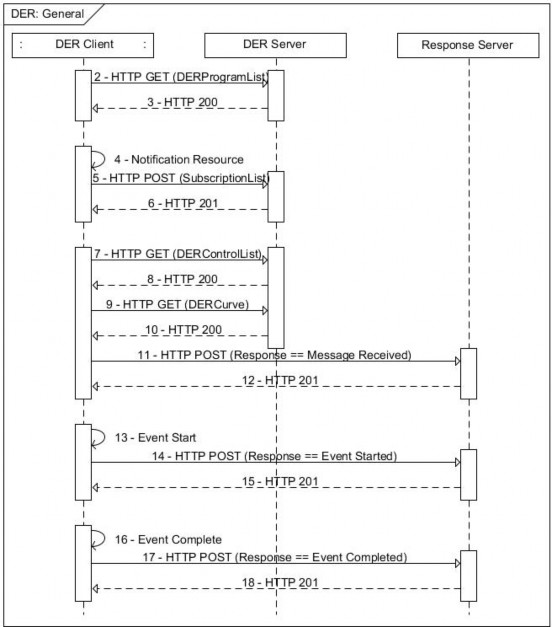
C.10 Distributed energy resource: General
Figure C.9—Distributed energy resource: general
Table C.11—POX example: Distributed energy resource: general
Step | Description |
1 | The client discovers a server of its EndDevice instance and GETs its FunctionSetAssignments (FSA). Through its FSA the client discovers it is enrolled in a DERProgram (enrollment occurs out of band). The client registers with the specified DERProgram server if a secure connection is required. |
2 | Client GETs the DERProgramList specified in its FSA. Client sends the following request, in this case indicating that it can accept either EXI or XML: GET /derp HTTP/1.1 Host: {hostname} Accept: application/sep+xml; level=+S1 |
3 | The DER server responds with the requested DERProgramList, for example: HTTP/1.1 200 OK Content-Type: application/sep+xml Content-Length: {contentLength} <DERProgramList all="1" href="/derp" results="1" xmlns="urn:ieee:std:2030.5:ns"> <DERProgram href="/derp/0"> <mRID>01BE7A7E57</mRID> <description>Example DER Program</description> <DERControlListLink all="2" href="/derp/0/derc"/> <primacy>2</primacy> </DERProgram> </DERProgramList> |
4 | The client locates or creates a local Notification resource that can be used to receive notification of changes to the DERControlList. |
5 | The client POSTs the URI of the Notification resource, together with the DERControlListLink it read from the DERProgram, to the subscription list of its EndDevice instance on the DER server. POST /edev/0/sub HTTP/1.1 Host: {hostname} Content-Type: application/sep+xml Content-Length: {contentLength} <Subscription xmlns="urn:ieee:std:2030.5:ns"> <subscribedResource>http://server.example.com/derp/0/derc</subscribedResource> <encoding>0</encoding> <level>+S1</level> <limit>0</limit> <notificationURI>http://client.example.com/ntfy</notificationURI> </Subscription> |
6 | The DER server responds with Status 201 Created. In the future, the DER server will “push” DERControlList updates to the client. HTTP/1.1 201 Created Location: /edev/0/sub/1 Content-Length: 0 |
7 | Client GETs the list of DERControls from the DER server. Client sends the following request, in this case asking for the first element of the list: GET /derp/0/derc?s=0&l=1 HTTP/1.1 Host: {hostname} Accept: application/sep+xml; level=+S1 |
Table C.11—POX example: Distributed energy resource: general (continued) | |
Step | Description |
8 | DER server responds with the first DERControl on the list. Server sends the following response: HTTP/1.1 200 OK Content-Type: application/sep+xml Content-Length: {contentLength} <DERControlList all="2" href="/derp/0/derc" results="1" subscribable="1" xmlns="urn:ieee:std:2030.5:ns"> <DERControl> <mRID>02BE7A7E57</mRID> <description>Example DERControl 1</description> <creationTime>1341446390</creationTime> <EventStatus> <currentStatus>1</currentStatus> <dateTime>1341532800</dateTime> <potentiallySuperseded>false</potentiallySuperseded> </EventStatus> <interval> <duration>86400</duration> <start>1341446400</start> </interval> <randomizeDuration>180</randomizeDuration> <randomizeStart>180</randomizeStart> <DERControlBase> <opModVoltWatt href="/derp/0/dc/3"/> </DERControlBase> </DERControl> </DERControlList> |
9 | The DERControl above calls for dynamic (curve-based) Volt-Var Control mode. The specified curve URI is “/derp/0/dc/3”. The client GETs the DERCurve: GET /derp/0/dc/3 HTTP/1.1 Host: {hostname} Accept: application/sep+xml; level=+S1 |
Table C.11—POX example: Distributed energy resource: general (continued) | |
Step | Description |
10 | The DER server responds with the requested DERCurve. Client should check the curveType to ensure it is Volt-Var. In this example (see Figure 4) the delivered reactive power remains at 50% of statVarAvail (positive sign indicates delivered or over-excited, yRefType==3 indicates %statVarAvail) as long as the effective percent voltage is at or below 99% of nominal. When the voltage is at 100% of nominal, no reactive power is delivered. As the voltage climbs above nominal, reactive power is received (negative sign indicates under-excited). Voltage may jitter slightly within the dead band created by the four curve points without affecting the reactive power output. HTTP/1.1 200 OK Content-Type: application/sep+xml Content-Length: {contentLength} <DERCurve href="/derp/0/dc/3" xmlns="urn:ieee:std:2030.5:ns"> <mRID>04BE7A7E57</mRID> <description>An example Volt-VAr curve</description> <creationTime>1341446380</creationTime> <CurveData> <xvalue>99</xvalue> <yvalue>50</yvalue> </CurveData> <CurveData> <xvalue>103</xvalue> <yvalue>-50</yvalue> </CurveData> <CurveData> <xvalue>101</xvalue> <yvalue>-50</yvalue> </CurveData> <CurveData> <xvalue>97</xvalue> <yvalue>50</yvalue> </CurveData> <curveType>11</curveType> <rampDecTms>600</rampDecTms> <rampIncTms>600</rampIncTms> <rampPT1Tms>10</rampPT1Tms> <xMultiplier>0</xMultiplier> <yMultiplier>0</yMultiplier> <yRefType>3</yRefType> </DERCurve> |
11 | For each DERControl with ResponseRequired Bit 0 set, the Client POSTs a response with a status of “Message Received” to the response resource specified by the replyTo field in the DERControl. Client sends the following: POST /rsp HTTP/1.1 Host: {hostname} Content-Type: application/sep+xml Content-Length: {contentLength} <DERControlResponse xmlns="urn:ieee:std:2030.5:ns"> <createdDateTime>1341507000</createdDateTime> <endDeviceLFDI>C0FFEE00</endDeviceLFDI> <status>1</status> <subject>02BE7A7E57</subject> </DERControlResponse> |
12 | Response server responds with: HTTP/1.1 201 Created |
13 | Client begins the event at the specified start (or current) time. |
Table C.11—POX example: Distributed energy resource: general (continued) | |
Step | Description |
14 | Client POSTs a response with a status of “Event Started” to the Response resource specified by the replyTo field in the DERControl. Client sends the following: POST /rsp HTTP/1.1 Host: {hostname} Content-Type: application/sep+xml Content-Length: {contentLength} <DERControlResponse xmlns="urn:ieee:std:2030.5:ns"> <createdDateTime>1341507010</createdDateTime> <endDeviceLFDI>C0FFEE00</endDeviceLFDI> <status>2</status> <subject>02BE7A7E57</subject> </DERControlResponse> |
15 | Response server responds with: HTTP/1.1 201 Created |
16 | Client completes the event. |
17 | Client POSTs a response with a status of “Event Completed” to the response resource specified by the replyTo field in the DERControl. Client sends the following: POST /rsp HTTP/1.1 Host: {hostname} Content-Type: application/sep+xml Content-Length: {contentLength} <DERControlResponse xmlns="urn:ieee:std:2030.5:ns"> <createdDateTime>1341532810</createdDateTime> <endDeviceLFDI>C0FFEE00</endDeviceLFDI> <status>3</status> <subject>02BE7A7E57</subject> </DERControlResponse> |
18 | Response server responds with: HTTP/1.1 201 Created |