C.8 Demand response: General
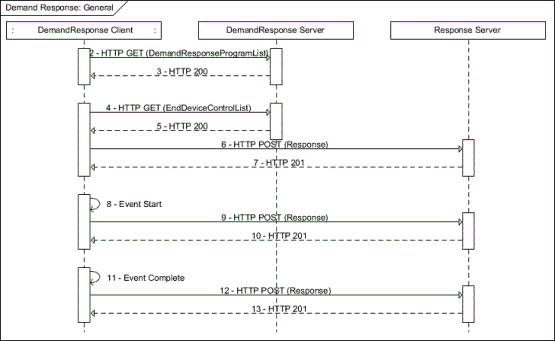
Figure C.7—Demand response: General
Table C.9—POX example: Demand response: general
Step | Description |
1 | The client has discovered its EndDevice instance on the server with a link to its FunctionSetAssignments. Within its FunctionSetAssignments, the client discovers it is part of a DemandResponseProgram. The enrollment is provided out of band. |
2 | Client GETs the list of DemandResponsePrograms from the Demand Response Load Control (DRLC) server. Client sends the following request: GET /drp?l=2 HTTP/1.1 Host: {hostname} Accept: application/sep+xml |
Table C.9—POX example: Demand response: general (continued) | |
Step | Description |
3 | DemandResponse server responds with the list of DemandResponsePrograms. Server sends the following response: HTTP/1.1 200 OK Content-Type: application/sep+xml Content-Length: {contentLength} <DemandResponseProgramList all="2" results="2" subscribable="0" xmlns="urn:ieee:std:2030.5:ns"> <DemandResponseProgram href="/drp/1"> <mRID>0FB7</mRID> <description>Operation X</description> <ActiveEndDeviceControlListLink all="0" href="/drp/1/aedc"/> <EndDeviceControlListLink all="1" href="/drp/1/edc"/> <primacy>0</primacy> </DemandResponseProgram> <DemandResponseProgram href="/drp/2"> <mRID>80000001</mRID> <description>The Wackness</description> <ActiveEndDeviceControlListLink all="0" href="/drp/2/aedc"/> <EndDeviceControlListLink all="0" href="/drp/2/edc"/> <primacy>1</primacy> </DemandResponseProgram> </DemandResponseProgramList> |
4 | Client GETs the list of EndDeviceControls from the DRLC server for the desired DemandResponseProgram. Client sends the following request: GET /drp/1/edc HTTP/1.1 Host: {hostname} Accept: application/sep+xml |
Table C.9—POX example: Demand response: general (continued) | |
Step | Description |
5 | DemandResponse server responds with the list of EndDeviceControls. Server sends the following response: HTTP/1.1 200 OK Content-Type: application/sep+xml Content-Length: {contentLength} <EndDeviceControlList all="1" results="1" subscribable="0" xmlns="urn:ieee:std:2030.5:ns"> <EndDeviceControl href="/drp/1/edc" replyTo="{hostname}/rsp" responseRequired="01" subscribable="0"> <mRID>CAFEFEED</mRID> <description>Emergency One Hour Coffee Brew</description> <creationTime>1234556</creationTime> <EventStatus> <currentStatus>0</currentStatus> <dateTime>1234556</dateTime> <potentiallySuperseded>false</potentiallySuperseded> <reason>Need Caffeine Soon</reason> </EventStatus> <interval> <duration>360</duration> <start>1234900</start> </interval> <randomizeDuration>60</randomizeDuration> <randomizeStart>60</randomizeStart> <deviceCategory>08</deviceCategory> <drProgramMandatory>true</drProgramMandatory> <loadShiftForward>true</loadShiftForward> <SetPoint> <heatingSetpoint>10000</heatingSetpoint> </SetPoint> </EndDeviceControl> </EndDeviceControlList> |
6 | For each EndDeviceControl with ResponseRequired Bit 0 set, the client POSTs a response with a status of “Event Received” to the response resource specified by the replyTo field in the EndDeviceControl. Client sends the following: POST /rsp HTTP/1.1 Host: {hostname} Content-Type: application/sep+xml Content-Length: {contentLength} <DrResponse xmlns="urn:ieee:std:2030.5:ns"> <createdDateTime>1234560</createdDateTime> <endDeviceLFDI>C0FFEE00</endDeviceLFDI> <status>1</status> <subject>CAFEFEED</subject> </DrResponse> |
7 | Response server replies with Status 201 Created: HTTP/1.1 201 Created |
8 | Client begins the event at the defined start time. |
Table C.9—POX example: Demand response: general (continued) | |
Step | Description |
9 | Client POSTs a response with a status of “Event Started” to the response resource specified by the replyTo field in the EndDeviceControl. Client sends the following: POST /rsp HTTP/1.1 Host: {hostname} Content-Type: application/sep+xml Content-Length: {contentLength} <DrResponse xmlns="urn:ieee:std:2030.5:ns"> <createdDateTime>1234900</createdDateTime> <endDeviceLFDI>C0FFEE00</endDeviceLFDI> <status>2</status> <subject>CAFEFEED</subject> </DrResponse> |
10 | Response server responds with Status 201 Created: HTTP/1.1 201 Created |
11 | Client completes the event. |
12 | Client POSTs a response with a status of “Event Completed” to the response resource specified by the replyTo field in the EndDeviceControl. Client sends the following: POST /rsp HTTP/1.1 Host: {hostname} Content-Type: application/sep+xml Content-Length: {contentLength} <DrResponse xmlns="urn:ieee:std:2030.5:ns"> <createdDateTime>1235260</createdDateTime> <endDeviceLFDI>C0FFEE00</endDeviceLFDI> <status>3</status> <subject>CAFEFEED</subject> </DrResponse> |
13 | Response server responds with Status 201 Created: HTTP/1.1 201 Created |